Monolith vs Microservices: A Quick Overview for Java Developers 🧩
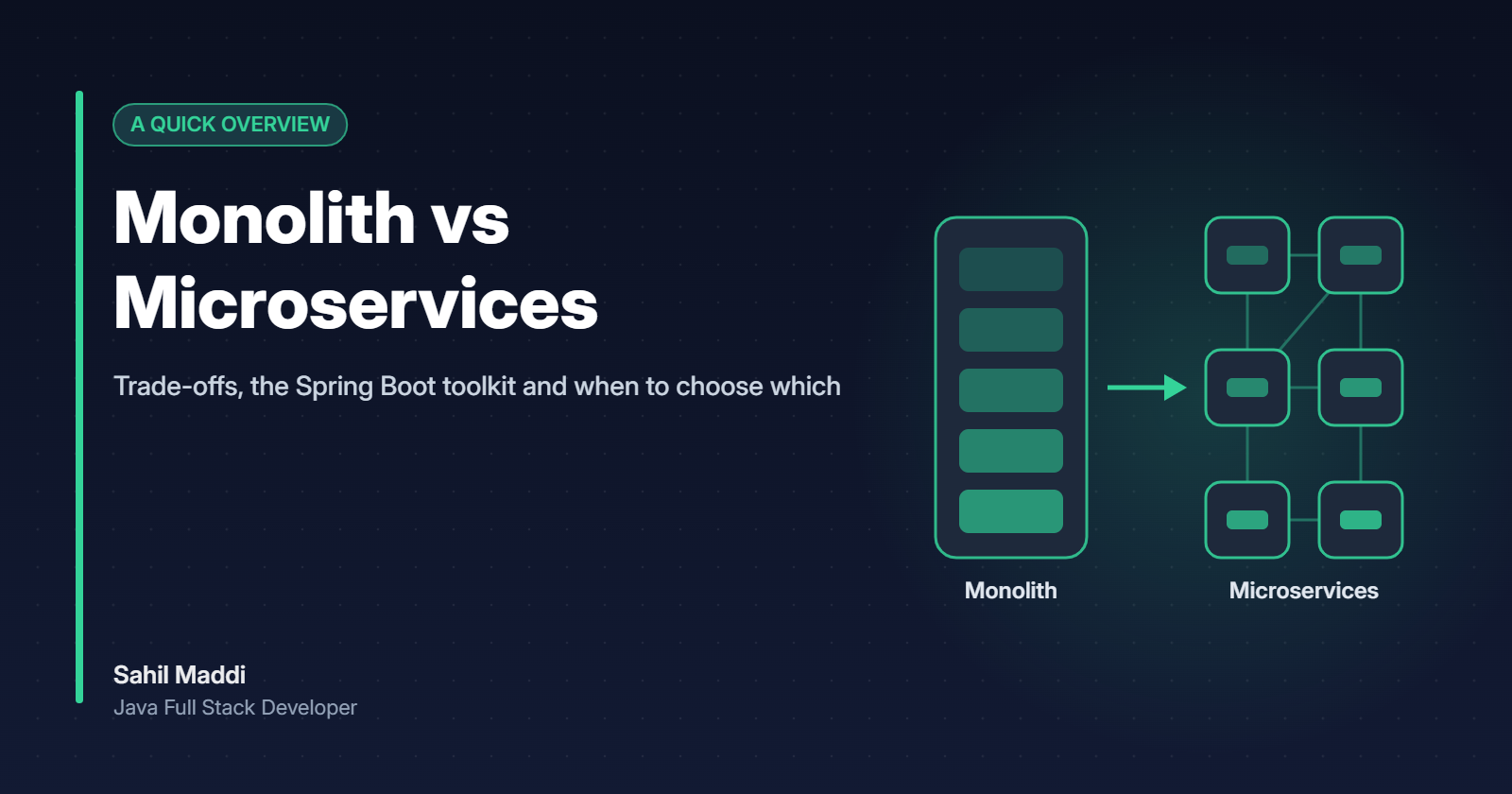
"Should we build microservices?" is one of the most common architecture questions in Java teams today. Microservices power some of the world's largest systems, but a well-structured monolith is still the right choice for many projects. This quick overview compares the two, with a focus on the Spring Boot ecosystem.
What is a monolith? 🏛️
A monolith is a single application that contains all features (users, orders, payments, notifications) in one codebase, built and deployed as one unit, usually backed by one database.
Pros:
- Simple to build and run: one project, one build, one deployment.
- Easy local development and debugging: you can step through the whole flow in one IDE session.
- Fast in-process calls: modules talk through method calls, not network requests.
- Simple transactions: a single database makes consistency straightforward.
Cons:
- Everything scales together: if only the search feature is busy, you still scale the whole app.
- Slower releases as it grows: a small change requires redeploying everything.
- Tight coupling over time: without discipline, modules start depending on each other's internals.
What are microservices? 🧩
Microservices split the system into small, independently deployable services, each owning one business capability and usually its own database. Services communicate over the network, using REST APIs or messaging systems like Apache Kafka.
Pros:
- Independent deployments: the payments team can release without waiting for the orders team.
- Independent scaling: scale only the services under load.
- Fault isolation: if the recommendations service fails, checkout can keep working.
- Technology freedom: each service can choose the tools that fit its job.
Cons:
- Operational complexity: more services means more deployments, monitoring, logging and configuration.
- Network overhead and failures: every call between services can be slow or fail, so you need timeouts and retries.
- Distributed data: keeping data consistent across services needs patterns like Saga instead of simple database transactions.
- Harder debugging: a single request can cross many services, so you need distributed tracing.
The Spring Boot microservices toolkit 🧰
Spring Boot and Spring Cloud provide ready-made building blocks for the common problems:
- Service discovery: Eureka lets services find each other without hard-coded URLs.
- API gateway: Spring Cloud Gateway gives clients a single entry point and handles routing, authentication and rate limiting.
- Centralised configuration: Spring Cloud Config keeps settings for all services in one place.
- Resilience: Resilience4j adds circuit breakers, retries and timeouts.
- Messaging: Apache Kafka or RabbitMQ for event-driven communication between services.
- Observability: Micrometer and distributed tracing (for example, Zipkin) to follow a request across services.
- Containers: Docker packages each service, and Kubernetes or a cloud platform runs and scales them.
Side-by-side comparison
| Monolith | Microservices | |
|---|---|---|
| Codebase | One | Many, one per service |
| Deployment | Whole app at once | Each service independently |
| Scaling | Entire app | Per service |
| Database | Usually one shared | Usually one per service |
| Communication | In-process method calls | REST APIs, messaging |
| Transactions | Simple, local | Distributed (Saga, events) |
| Team fit | Small to medium teams | Multiple teams, clear domains |
| Operational effort | Low | High |
When to choose which
Start with a monolith when:
- The team is small or the product is new and still changing fast.
- Domain boundaries aren't clear yet.
- You don't have the infrastructure for monitoring, tracing and CI/CD across many services.
Move to microservices when:
- Different parts of the system need to scale very differently.
- Several teams need to release independently.
- Clear business boundaries exist, such as orders, payments and inventory.
The middle ground: the modular monolith 🧱
Many teams start with a modular monolith: one deployable app, but organised into well-separated modules with clear interfaces and no shared internals. In Spring, Spring Modulith helps define and verify these module boundaries. If a module later needs to scale or deploy on its own, extracting it into a microservice is much easier because the boundary already exists.
Conclusion
Microservices aren't an upgrade from monoliths; they're a trade-off. A monolith gives you simplicity and speed of development, while microservices give you independent scaling and deployments at the cost of operational complexity. For most new projects, a well-structured (modular) monolith is the smart start, and Spring Boot's ecosystem makes it straightforward to break out microservices when the need is real. 🚀
Comments
Join the discussionNo comments yet. Be the first to comment.